
When small, an organization is typically vibrant and innovative. Employees are engaged, connected and feel a part of something special – I know, I was part of that once too. However, as the organization grows, these attitudes and behaviors can change; the environment becomes more closed, leadership moves out of the day-to-day, work is less visible, connections grow but each becomes a weaker relationship. This is what I call social atrophy.
What’s the risk? Well, if you define social as community, collaboration and sharing then as these diminish, so too does the seeds of innovation and creativity which are a necessity in a rapidly changing marketplace.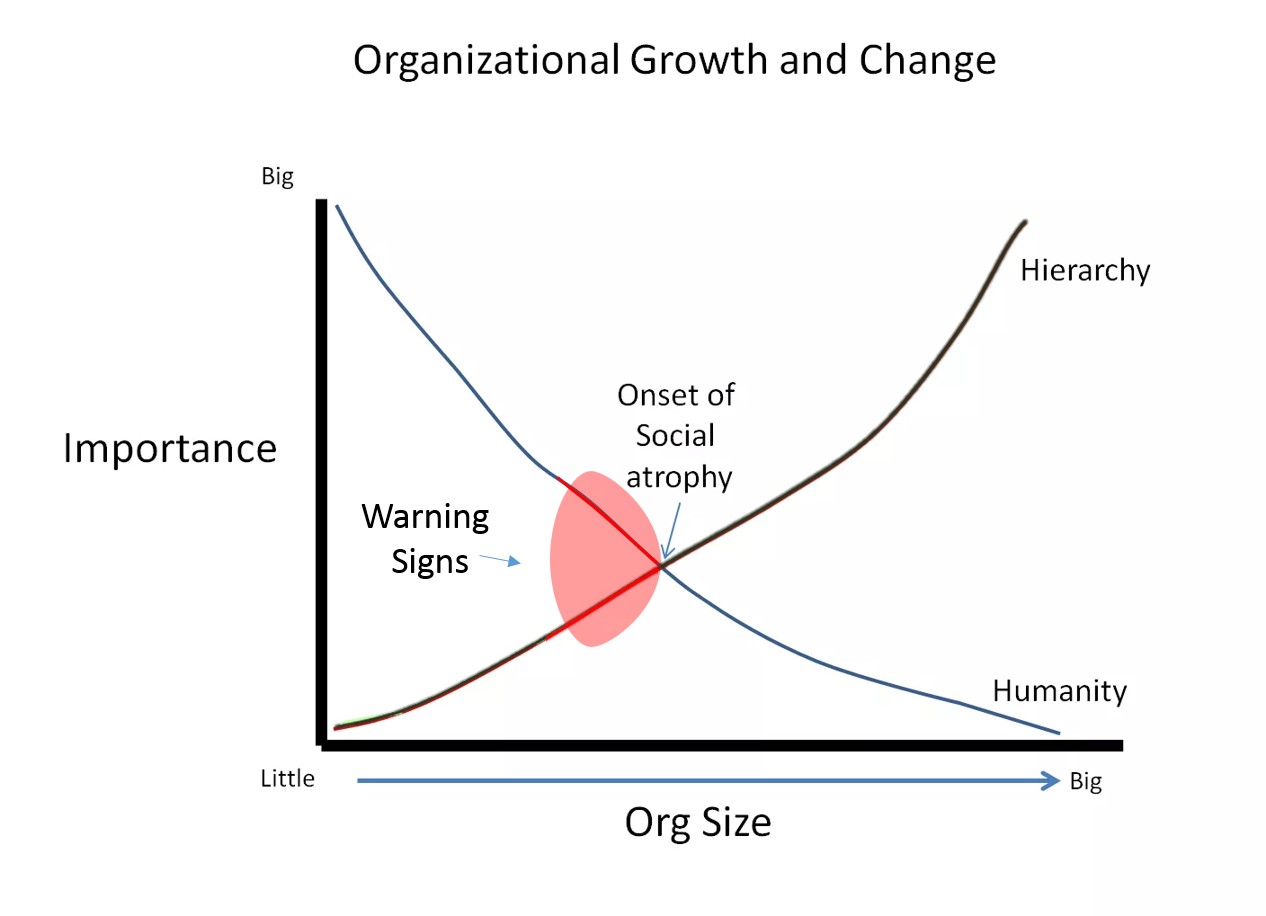
I attempt to visualize the shift in the image above (a revisit of my previous look at Social Atrophy). Notice that when the organization is small, being human (sharing, collaboration, camaraderie, error tolerance) is a big part of the day-to-day and hierarchy is really just in name only. As the organization grows however so too does the rigidity of hierarchy leading to a decline in humanity. The space between people grows as passion’s void is filled by many unnecessary policies, procedures and posturing.
Can we be more conscious of the decline of social at any level in an organization and head it off so as to not to reach the need of large-scale, painful organizational culture change efforts?
Here are a few warning signs to consider:
- Increasing rate of turn-over
- Impersonal announcements of employee departures
- Departments becoming insular
- New layers of management appearing
- Communication moves increasingly top down
- Titles and roles become more important and desirable
- “That’s not my job” over takes “I’ll do it”
- Process becomes inflexible
- Learning is seen as something to complete not ongoing
- Knowledge hoarding becomes the norm
Are all of these unavoidable? Are all equal in weight? I think not. For example process can be very important but when it goes unquestioned over time it becomes a sacred cow and a drag on business. The same can be said for new level’s of management. If the management philosophy and practice is open and transparent, then simply having more is not inherently a bad thing. So this list is not exhaustive or without it’s caveats of course but I am curious of what other signs of social atrophy have you seen? Has your organization addressed them or tried headed them off?
If this made you think, pass it along.
Very timely post for me, Mark. I just finished hearing the CEO of a healthcare company talk about his top goals and his number one thing for success is “human interactions”. (Also interesting that he comes from a learning background. )
Great stuff as always. Thanks!
That’s a very positive sign! Rare of course too. I wish that CEO well as sometimes, as we know, the system can chew up and spit out the best plans… unless of course his plans are about changing the system! Thanks for reading Mike!
Interesting. I especially keyed in on error tolerance which I assume becomes a tricky balance as a company grows.
This also made me think of an assistant job I held at a school, direct care, more social service than corporate. During orientation I sat at lunch with another new person who was taking a director position. I mentioned I was excited because people here must live their jobs since many held their positions for 10+ years, his response surprised me. He said it’s either they like it or have become complacent and just put in the hours.
Unfortunately he was right. I can place a check near every sign of social atrophy listed. The worst part is that I worked with a lot of intelligent people whose knowledge and insight were not at all fostered.
Sadly true. Many set out to change lives but get beaten down by the system, fear job loss or stick it out for the benefits and vacation time… dialing it in. It’s funny how many organizations fight to lower turn over but is that always a good thing?? Yes, consistency in process and product can be maintained and regulars are a comfortable sight for the status quo but if people remain for the wrong reasons is it advancing the organization?